


ReelShort's "Things I Wanted to Say" Could Be a Glimpse Into the Future of Book Adaptations

With its latest short drama, Reelshort brings Monica Murphy's BookTok sensation to life.
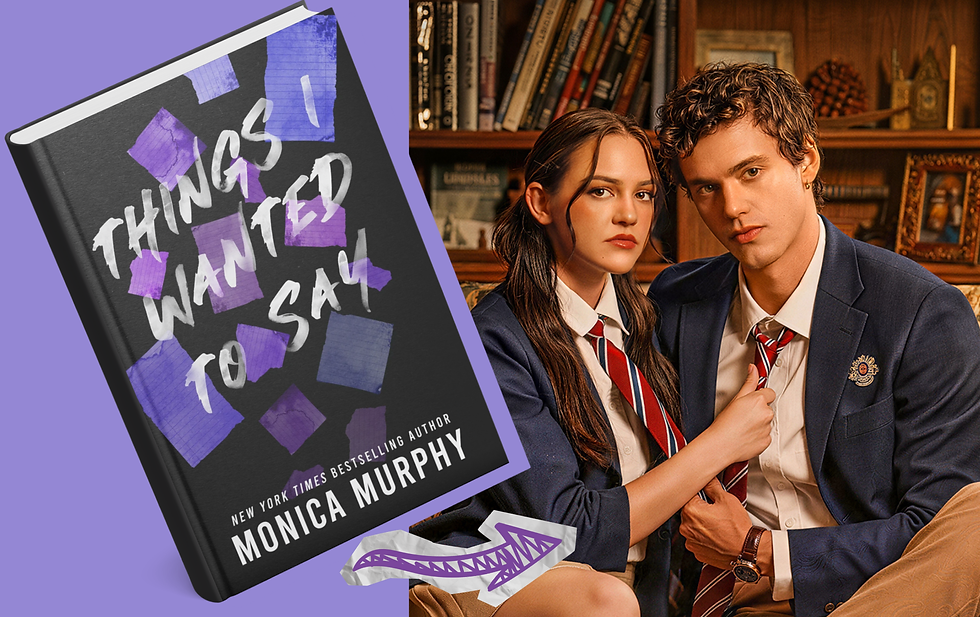
When ReelShort announced they were adapting Things I Wanted to Say by Monica Murphy, I was immediately curious. On paper, it seemed like the perfect match: one of BookTok's biggest dark romance hits getting turned into a vertical drama for an audience that's already obsessed with bingeable romance.
After watching it, I don't just think it's one of ReelShort's better releases—I think it might be a glimpse into where book adaptations are headed.
From BookTok Favorite to Vertical Drama
BookTok hit Things I Wanted to Say is the first book in Monica Murphy's wildly popular Lancaster Prep series. It's a dark high school romance following Summer Savage and her rich bully Whit Lancaster, who steals her diary and uses it as leverage against her. The story unfolds with flaring tempers, high heat, and a slow blurring of the line between love and hate.
Premiering June 30, the ReelShort adaptation transforms Monica Murphy's viral romance into a bingeable vertical series, starring Kirby Ellwood as Summer and Pablo Kaestli as Whit.
Reelshort Has Been Making Moves in Bookish Spaces
This actually isn't ReelShort's first attempt at adapting existing romance novels. They've tackled Breathe by Abbi Glines, The Words by Ashley Jade, Monster in His Eyes by J.M. Darhower, and probably their biggest adaptation before this, L.J. Shen's Vicious.
That strategy is starting to make ReelShort stand out from the growing crowd of vertical drama apps, and Things I Wanted to Say feels like the next step in their evolution.
Why This Monica Murphy Adaptation Totally Worked
Out of all the ReelShort book adaptations I've watched, Things I Wanted to Say is the first one that actually felt like an actual... adaptation.
That might sound obvious, but previous adaptations often felt like familiar recycled vertical drama plots wearing a different title. Here, I could actually recognize Monica Murphy's storytelling and narrative style.
The biggest difference was the characters: Summer immediately felt like more than the typical one-dimensional vertical drama heroine. She has personality, backbone, and isn't afraid to push back. I loved watching her straight-up slug Whit when his bullying crossed the line.
The adaptation also made an effort to include Summer's inner monologue, which helped preserve Monica Murphy's voice. That little addition made a surprisingly big difference.
Some Hits and Some Misses
That's not to say I thought everything worked perfectly. Ironically, the moments that felt weakest were the ones where ReelShort slipped back into its usual formula.
Every so often the adaptation would throw in one of those familiar over-the-top vertical drama twists that didn't really exist in the novel, and they honestly felt unnecessary. The source material already has enough tension without forcing extra melodrama into it.
The spice was definitely there, although I wouldn't complain if ReelShort pushed things a little further in future adaptations. Romance readers generally aren't afraid of steam, and I think there's still room for these adaptations to embrace that side of the genre a bit more.
Why This Feels Like the Beginning of a Bigger Trend
More than anything, watching Things I Wanted to Say made me feel like I was seeing the early version of something much bigger.
Romance has always been one of the most successful genres in publishing, but it's oddly underrepresented in traditional film. Big studios often chase expensive action movies or fantasy franchises, but these days it seems like they're almost afraid to go for romance.
Vertical dramas have the opportunity to pick up where the studios leave off. At its core, romance is just about two people interacting. You don't need massive CGI budgets or elaborate action sequences. Strong dialogue, chemistry, and emotionally compelling relationships do most of the heavy lifting. That's exactly the kind of storytelling that works well within ReelShort's production model.
On top of that, romance readers represent an enormous audience, and I have to imagine there's significant overlap between people who devour BookTok recommendations and people who spend hours watching vertical dramas.
The adaptation opportunities are almost endless, too. Popular romance authors' backlist titles, viral Wattpad originals, AO3 fanfiction—there's an incredible amount of existing material ready to be made into something new.
ReelShort also seems uniquely positioned to capitalize on it. They've already built the infrastructure for fast, relatively low-budget productions; they've gotten good at identifying charismatic young actors with real star potential; and their writers understand how to distill a story down to its emotional core.
What's Next?
Reelshort's Things I Wanted to Say feels like a strong proof of concept for what other future vertical drama adaptations could look like. It genuinely felt like the creative team cared about translating the book instead of simply borrowing its title. It was truer to the characters, captured much of Monica Murphy's voice, and proved that these stories can work in the vertical format without losing what made readers fall in love with them in the first place.
If Reelshort keeps refining this formula, we could be looking at the beginning of an entirely new lane for romance adaptations.
Read More: Mega Reelshort Review - What to Watch
Watch on Reelshort: Things I Wanted to Say


Comments